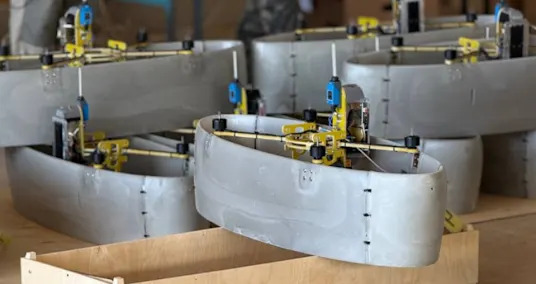
Russia has unveiled a new fiber optic first-person-view attack drone called the KVS, featuring a ring shaped wing design. The more important question is what problem Russia is trying to solve with it.
The answer appears to lie in the changing geometry of drone warfare. The current battlefield stalemate is not just the result of stronger defenses on the front line, but of both sides trying to isolate the combat zone behind it.
The struggle is increasingly about who can strike deeper into the rear with drones, hitting vehicles, logistics, launch crews and resupply routes before they reach the line of contact. Russia’s new KVS looks like an attempt to regain reach in that contest.
For a time, Russian fiber optic drones held an advantage. Ukraine also fielded fiber optic systems, but in smaller numbers. As Samuel Bendett, an adjunct senior fellow at the Center for a New American Security, told me, “Russia was the first mover when it comes to fiber optic drones, using them in the Kursk region.”
But that edge did not last. Olena Kryzhanivska, a defense analyst, told me both sides are experimenting with ways to extend the range of their drones, especially ordinary FPVs and fiber optic systems, which have the advantage of being resistant to jamming.
As the drone war stretched outward, though, that advantage became harder to hold. Alexey Chadaev, general director of the Ushkuynik Research and Production Center, wrote on Telegram on March 25 that Ukraine has used Starlink, relay drones and airborne “mothership” launch concepts to push cheap FPVs out to 50 to 60 kilometers or more. The loss of Starlink access for Russian forces in February would also have removed an important tool for extending medium and long range drone strikes.
Fiber optic control has one major weakness: distance. The farther the drone flies, the greater the chance the control line will snap. At shorter ranges, around 10 kilometers, that may be manageable. Beyond 20 kilometers, the odds begin to worsen.
But fiber optic drones still have important advantages where radio control struggles. “Dense forests block signals, so fiber is perfect,” Heiner Philipp, an engineer with Technology United for Ukraine, told me. He said radio controlled drones also struggle to reach targets in basements, trenches, tunnels, spaces under bridges and some dense urban areas, meaning fiber systems are often used when a radio controlled drone cannot reliably reach the target.

A fiber-optic-controlled drone is designed for the Ukrainian Armed Forces in the Kyiv region, Ukraine, on January 29, 2025. (Photo by Maxym Marusenko/NurPhoto via Getty Images)
NurPhoto via Getty ImagesUkraine is already working on a workaround. Militarnyi reported on March 22 that Ukrainian troops had tested an FPV drone with dual control channels, fiber optic and radio, so it could keep flying if one link was lost. The need arose from frequent cable breaks on longer flights, especially with larger drones carrying heavier payloads, as well as shortages of optical fiber.
According to material released by Chadaev, the KVS uses a 10 inch configuration, carries a payload reportedly comparable to the Knyaz Vandal Novgorodsky, and is intended for medium range strike missions. Its most distinctive feature is the ring shaped, or closed loop, wing. This links the wing tips together, reducing wingtip vortices and improving aerodynamic efficiency.
If that works in practice, the KVS may give Russia a relatively cheap strike drone able to fly farther without giving up payload, helping it compete in a drone war increasingly defined by range, cost and scale.
“While fiber optic FPVs are bigger and more expensive, they are designed to go after bigger targets, including very valuable self propelled artillery,” Roy Gardiner, an open source weapons researcher, told me. He added that as fiber optic cable for FPVs becomes more expensive, both sides will try harder than ever to prevent cable breakage in flight.

Soldiers from Ukraine's 419th Battalion of Unmanned Systems.
Photo: David KirichenkoTerrain also helps explain why fiber-optic drones continue to grow in importance in Ukraine. “Everything is different here in Sumy,” Andrii Pelypenko of Ukraine’s 419th Battalion of Unmanned Systems, told me. “There are many forests and ravines, which makes hunting down the Russians more difficult. We are using fiber optic drones much more now.”
Pelypenko said Russian infantry positions there are dug deeper, more heavily fortified and often covered with netting that makes it harder for fiber optic drones to get close. He also said Russian electronic warfare remains well developed, and that Russian assaults still tend to rely on small infantry groups rather than armored assaults.
That is why the fiber problem still matters. If the KVS works as intended, it could help Russia recover some of the reach it has been losing in the FPV war. If not, it will be another interesting design in a conflict that has already produced many of them.
NEUESTE BEITRÄGE
- 1
 The Most Compelling Books of the 10 years05.07.2023
 - 2Ariana Grande says Eternal Sunshine 2026 tour will be her last for a 'long, long time': 'One last hurrah'18.11.2025
- 37 Fun Plans to Make Film Evenings Seriously Invigorating (You'll Cherish #5!)25.12.2024
- 4PHOTO ESSAY: Summer camp for kids with autoimmune diseases18.11.2025
- 5Instructions to Comprehend and Use Open Record Extra Offers19.10.2023



Ähnliche Artikel
- Heavenly Pastry Confrontation: Pick Your #1 Sweet Treat!06.06.2024
- Lawsuit claims ChatGPT exacerbated man's delusions leading to murder-suicide11.12.2025
- A decade after Brazil’s deadly dam collapse, Indigenous peoples demand justice on the eve of COP3005.11.2025
- Russia earning billions from Hormuz blockade, German trade body says07.04.2026
- Pick Your Favored pizza beating06.06.2024
- Instructions to Plan for Your Teeth Substitution Methodology16.10.2023
- Florence's Uffizi Gallery moves treasures to safety after cyberattack03.04.2026
- Instructions to Choose the Best Material Organization for a Fruitful Rooftop Substitution17.10.2023
- Why is the Artemis 2 rocket launch different from all other rocket launches?01.04.2026
- At UN climate conference, some activists and scientists want more talk on reforming agriculture21.11.2025