When you buy through links on our articles, Future and its syndication partners may earn a commission.

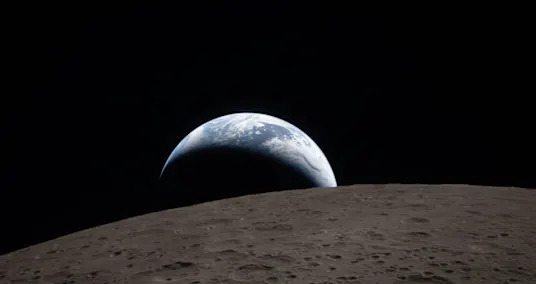
The Artemis 2 crewmembers captured a spectacular view of Earth setting behind the moon through the window of their Orion spacecraft on Flight Day 6 of NASA's historic 10-day mission, as they passed over the far side of the lunar surface. They called it "Earthset," in reference to the iconic image captured by Bill Anders on Christmas Eve in 1968 during the Apollo 8 mission.
What is it?
The photo was captured at 6:41 p.m. EDT (1041 GMT) on April 6, as the majority of Earth's surface was veiled in shadow from the perspective of the Artemis 2 crew. Just a crescent of our planet could be seen illuminated by direct sunlight, revealing white clouds swirling over Australia and Oceana.
Countless craters can be seen scarring the moon's ancient surface, including the 40-mile-wide (64-kilometer-wide) expanse of Ohm Crater, which can be seen close to where the lunar horizon meets the shadowed night side of Earth. The crater features a prominent central peak and a sloping "terraced" rim.

NASA's Reid Wiseman, Victor Glover and Christina Koch and the Canadian Space Agency's Jeremy Hansen — the crew of the Orion spacecraft they named "Integrity" — witnessed Earth slip silently from view shortly after, as they passed over the far side of the moon.
They would later experience a planned 40-minute communications blackout while traveling beyond the range of NASA's relay satellites. But then, they witnessed an iconic "Earthrise" even more similar to what Anders saw in the 60s, as our Blue Marble emerged from behind its natural satellite.

The most detailed Artemis SLS Lego set, this adult-aimed model has 3,601 pieces and stands 28-inches (71 cm) tall. We thought "Lego has knocked it out of the park" in our full build review. Don't forget about the newer, more compact and much cheaper Lego Technic SLS set, only $60, also 'launches' with some clever Technic moving parts.
Later that day, the crew would be treated to one of the rarest sights in human history, a total solar eclipse witnessed from a free-flying spacecraft, as Orion's trajectory placed the moon between the NASA spacecraft and our parent star.
Want to know more? Then be sure to stay up to date with the latest news with our Artemis 2 liveblog. You can also find out what the Orion crew will be getting up to over the rest of their 10 day lunar trip with our day-by-day breakdown of the trailblazing mission, which has seen humans travel farther from Earth than ever before.
NEUESTE BEITRÄGE
- 1
 Israeli archaeologists launch project to trace origins of ancient pottery12.01.2026
 - 2Merz: 80% of Syrians in Germany should return in three years30.03.2026
- 3Latvia seeks emergency UN meeting over Russian missile attack on Lviv09.01.2026
- 4The ‘Stranger Things’ finale, explained: What happens to Vecna? And why was a key character’s fate left unknown?02.01.2026
- 5Ultra-Orthodox protests erupt across Israel on haredi IDF enlistment day04.01.2026




Ähnliche Artikel
- Without evidence, CDC changes messaging on vaccines and autism20.11.2025
- The Magnificence of Extraordinariness: Presenting Valuable Adornments and Gemstones05.06.2024
- Everything you should know before booking a trip to Spain28.11.2025
- Figure out How to Function Successfully with Your Auto Collision Legal advisor for the Best Result19.10.2023
- Step by step instructions to Guarantee Your Fender bender Legal counselor has Areas of strength for a Record19.10.2023
- Do-It-Yourself Home Style on a Careful spending plan: Imaginative Thoughts and Tasks01.01.1
- All that You Really want to Be familiar with Dental Inserts Facilities01.01.1
- Executed Iranian nuclear scientist confessed to aiding Israel after torture, threats against mother13.12.2025
- Tickets for 'Stranger Things' Season 5 finale, to be shown in movie theaters on New Year's Eve, go on sale today. Here's how you can save your seat.02.12.2025
- Phenomenal Web-based MBA Stages for Proficient Headway05.06.2024


