By Marta Serafinko
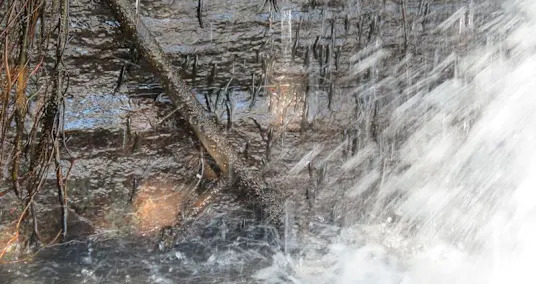
April 7 (Reuters) - A species of small fish has been observed by the thousands climbing a vertical waterfall 15 metres (50 feet) tall in the Democratic Republic of Congo in a behaviour that illustrates the surprising and ingenious ways animals can adapt to extreme environments.
The researchers documented how this species of shellear fish, whose scientific name is Parakneria thysi, scales the Luvilombo Falls in the upper Congo Basin, a vast river system spanning Central Africa and home to the world's second-largest rainforest. Researchers observed the fish ascending the vertical rock face during seasonal floods at the end of the rainy season, typically in April and May.
While this species can reach about 9.8 centimetres (3.9 inches) long, the researchers observed only small to medium-sized individuals - about 3.7 to 4.8 cm (1.5 to 1.9 inches) long - journeying up the falls.
Observations suggest a fish may take nearly 10 hours to complete the slow and demanding climb to the top, moving in short bursts and resting frequently. Larger individuals of the species appeared to be too heavy for their fins to support the climb.
"This discovery highlights the importance of maintaining the continuity of watercourses, particularly in the context of the Congo Basin, where studies on fish behaviour are virtually nonexistent," said Pacifique Kiwele, a researcher in ichthyology and a member of the scientific staff at the Université de Lubumbashi in the Democratic Republic of Congo who was the lead author of the study published in the journal Scientific Reports.
"It prompts scientists to be even more vigilant in their observations, as anything is possible. Who would have believed it without being close enough to check, and document it with photographic and film material, that indeed some fish are able to climb waterfalls? It illustrates that there are wonders out there that surpass our imagination," Kiwele said.
Some other fish species are capable of scaling waterfalls through various means but the researchers said this species is the first one documented in Africa.
The researchers recorded the behaviour of this shellear fish on four occasions in 2018 and 2020, observing them moving up the rock face through what is called the splash zone - areas kept wet by spray rather than direct water flow.
So how do they do it? The fish cling to wet rock surfaces using their pectoral fins, supported by pelvic fins and aided by tiny hook-like projections known as unculi, which help them grip surfaces, the researchers said. Then they push themselves upward by wiggling their bodies from side to side.
Scaled to human size, it would be comparable to a person climbing hundreds of metres (yards) vertically.
The ascent is also risky. Some fish lose their grip when sudden jets of water hit them, knocking them off the rock face - particularly when they flip upside down to navigate overhanging sections.
Given the volume of water at the base of the falls, fish that fall are most likely able to start climbing again. However, those landing directly onto rocks may not survive, the researchers said.
So why do they do it? The researchers said the fish may climb upstream to find suitable living conditions and areas of the waterway with less competition and fewer predators.
The researchers identified two major human threats to the species: illegal fishing using fine-mesh mosquito nets that can easily catch the fish, and water extraction for irrigation, which has in some years depleted the Luvilombo River.
The discovery underscores how little is known about fish behaviour in the Congo Basin, the researchers said.
"It is quite possible that other fish species living in rapid habitats ... are capable of overcoming similar vertical obstacles," Kiwele said, adding that researchers plan further fieldwork to confirm preliminary observations in another fish family.
(Reporting by Marta Serafinko in Gdansk, Poland; Editing by Will Dunham)
NEUESTE BEITRÄGE
- 1
 OECD: Iran war dampening global growth26.03.2026
 - 2An Extended time of Self-Reflection: Self-awareness through Journaling25.09.2023
- 3The Job of a Migration Legal advisor: How They Can Help You30.06.2023
- 4Relish the World: Notable Caf\u00e9s You Really want to Attempt05.06.2024
- 5What’s your chronotype? Knowing whether you’re a night owl or an early bird could help you do better on tests and avoid scams06.12.2025



Ähnliche Artikel
- If everyone on Earth sat in the ocean at once, how much would sea level rise?29.03.2026
- New ‘Cloud-9’ object could reveal the secrets of dark matter08.01.2026
- UK consumer confidence plunges amid escalating Iran conflict27.03.2026
- 4 injured in shooting at North Carolina tree lighting ceremony22.11.2025
- Investigating Remarkable Espresso Flavors: Upgrade Your Day to day Blend30.06.2023
- Vote in favor of your Number one Kind of Gems06.06.2024
- The most effective method to Promoter for Cutthroat Medical attendant Compensations in Your Medical services Office17.10.2023
- How a toxic self-improvement trend with a funny name took over your feed26.03.2026
- ‘This year nearly broke me as a scientist’ – US researchers reflect on how 2025’s science cuts have changed their lives18.12.2025
- Meet the Stars of the Feline World: Well known Pet Feline Varieties06.06.2024