When you buy through links on our articles, Future and its syndication partners may earn a commission.

Astronomers have used the James Webb Space Telescope to study the star-forming region called W51, revealing "hidden" stars that were invisible to other telescopes.
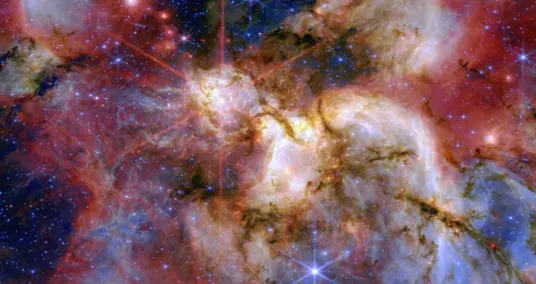
The investigation has resulted in some absolutely stunning images that show the lanes of gas and dust illuminated by these young stars in unprecedented detail.
The team behind these observations was able to use the $10 billion space telescope to determine that the stars in W51 began to form within the last million years. If this makes these stellar infants sound ancient, consider that our middle-aged star, the sun, is around 4.6 billion years old.
This is far from the first time that astronomers have captured images of W51, but the JWST observations reveal these young stars like never before.
That is because these still-growing stellar infants are shrouded in natal blankets of gas and dust that readily block and absorb light, preventing most telescopes from seeing them. But infrared light is able to slip through these clouds, and that is the type of electromagnetic radiation that the JWST uses to observe the cosmos.
"With optical and ground-based infrared telescopes, we can't see through the dust to see the young stars," team member and University of Florida researcher Adam Ginsburg said in a statement accompanying the images. "Now we can."

Aside from their considerable aesthetic value, the images are of great scientific interest too. They could help researchers determine how massive stars like those that populate W51 form. The formation mechanism of high-mass stars is much less well understood than that of low-mass stellar bodies.
"Because of James Webb, we can see those hidden, young massive stars forming in this star-forming region," team member Taehwa Yoo of the University of Florida said. "By looking at them, we can study their formation mechanisms."

With the massive leap in quality of the JWST, the team was able to discover hitherto unseen structures in W51. This included shockwaves rippling out from infant stars, giant bubbles of gas, and dark filaments of dust.

"They are not the first photos of this region, but they are the best. They're so much better that they essentially are brand new photos," Ginsburg said. "Every time we look at these images, we learn something new and unexpected."
NEUESTE BEITRÄGE
- 1
 The Significance of Health Projects in Senior Protection.19.10.2023
 - 2Unusual 'ingredients' helped stars form in a galaxy near the Milky Way14.01.2026
- 3How a Middle East War Becomes a Retail Price Hike26.03.2026
- 4Pick Your Number one Sort Of Music05.06.2024
- 5Charlotte faith leaders hold interfaith forum on Black and Palestinian solidarity26.03.2026




Ähnliche Artikel
- Christopher Nolan's 'The Odyssey' trailer: See Anne Hathaway, Matt Damon and Tom Holland in 1st look at movie22.12.2025
- Pick Your Number one breakfast food06.06.2024
- Figure out How to Use Your Nursing Abilities for Better Compensation17.10.2023
- China and Pakistan issue five-point peace plan for Middle East31.03.2026
- Google to Use Natural Gas to Power Massive Data Center in Texas07.04.2026
- Sustaining Public activity and Connections: Key Methodologies06.06.2024
- Is an $85 apple pie worth it? Our Thanksgiving taste test says … maybe.21.11.2025
- Bronze Age "City of Seven Ravines" unearthed in central Asia after 3,500 years18.11.2025
- All that You Really want to Be aware of Dental Inserts Facilities01.01.1
- Nodding off is dangerous. Some animals have evolved extreme ways to sleep in precarious environments19.12.2025