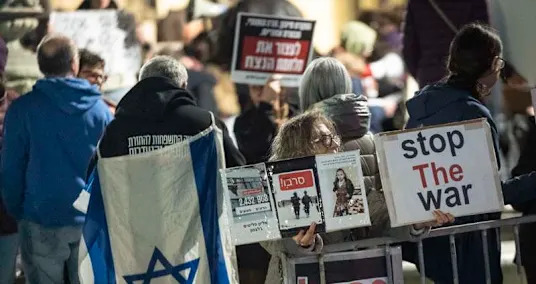
Demonstrators carried signs reading “We must stop” and “Bibi will kill us all,” while about 200 people gathered at Horev Junction in Haifa.
Anti-war demonstrations were held across Israel on Saturday evening, with protesters gathering in Tel Aviv, Haifa, Jerusalem, and Kfar Saba despite strict wartime restrictions on public assembly.
Demonstrators carried signs reading “We must stop” and “Bibi will kill us all,” while about 200 people gathered at Horev Junction in Haifa.
Earlier on Saturday, the Home Front Command granted an exceptional permit for a protest of up to 150 people at Habima Square in Tel Aviv, after state authorities told the High Court of Justice that demonstrations would be allowed only in a limited format and under tight attendance caps.
The Association for Civil Rights in Israel sought an urgent hearing, arguing that the restrictions harm the right to protest.

Security restrictions and court dispute
One IDF officer said the Home Front Command examined each requested protest site individually on operational, professional, and security grounds, including proximity to protected spaces. As a result, authorities did not approve a large gathering at Habima Square and instead allowed only 50 to 150 participants near a shelter.
The officer said the military declined to provide further details on all of its security considerations, but offered to present them to the court in a closed session.
“We are acting professionally and objectively. There is no political consideration here or any other consideration,” he said.
The requests covered several locations, including Habima Square in Tel Aviv, Horev Center in Haifa, Paris Square in Jerusalem, and Weizmann Street in Kfar Saba. In Tel Aviv, the state told the Supreme Court that the protest could proceed in two separate groups of up to 75 people each, for a total of 150 participants.
Protest groups push back
Police and the Home Front Command said the limits stemmed from operational and security concerns, against the backdrop of fears of missile fire and broader wartime restrictions on gatherings.
Civil rights lawyers, however, argued in court that earlier judicial remarks on the importance of political free expression during wartime had not been meaningfully implemented.
The dispute followed a tense High Court hearing on Friday, during which Supreme Court President Isaac Amit sharply criticized the state’s position.
The judges stressed that the right to protest does not disappear during war and said police should propose a framework that would allow demonstrations to proceed.
NEUESTE BEITRÄGE
- 1
 Most loved Web-based feature: Which Stage Do You Like01.01.1
 - 2The Century Coupe Could Be Toyota’s Most Ambitious Car Since the LFA06.04.2026
- 3Surprising links between autism, Alzheimer’s could change how we treat both05.04.2026
- 4Instructions to Help a Friend or family member Determined to have Cellular breakdown in the lungs17.10.2023
- 5One perk to marrying Richard Marx later in life? 'We don't have time' for stupid arguments, says Daisy Fuentes.27.11.2025





Ähnliche Artikel
- We tasted one of the 10,000 Hershey's Dubai chocolate bars being resold on eBay. Is it worth the hype?08.12.2025
- Geomagnetic storm grounds launch of Mars space weather satellites12.11.2025
- Elite Execution Gaming PCs for Gamers06.06.2024
- The Solution to Defeating Tarrying: Systems for Expanded Efficiency07.07.2023
- Computerized Moderation: Tracking down Equilibrium in the Advanced Age01.01.1
- Cocaine, caffeine, painkillers consumed by sharks in Bahamas, study finds26.03.2026
- New York to require social media platforms to display mental health warnings26.12.2025
- Tzrifin base exhibition reveals Hamas and Hezbollah arms, showing structure behind attacks12.01.2026
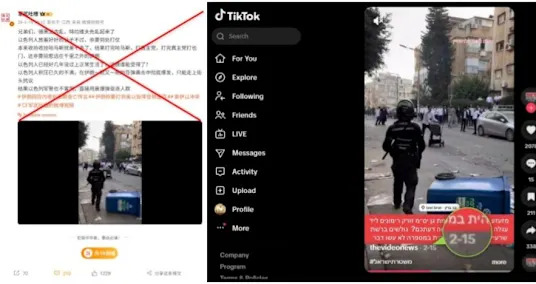
- Video of clashes over purported conscription orders misrepresented as anti-war protest in Israel29.03.2026
- ISS astronauts spy airglow and dwarf galaxy | Space photo of the day for Jan. 13, 202613.01.2026