Protests took place in Tel Aviv, Jerusalem, Haifa, and Beersheba, as a survey found broad but uneven support among Jewish Israelis for Operation Roaring Lion.
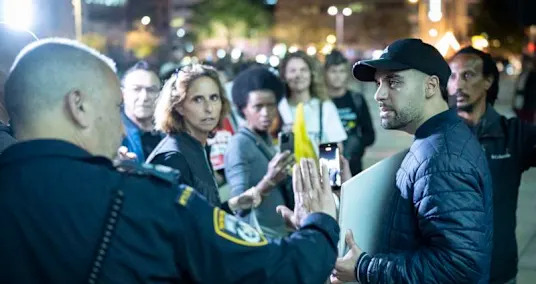
Israel Police arrested 21 anti-war protesters Saturday night as demonstrations against the conflict with Iran expanded in multiple cities despite restrictions on public gatherings.
Protests took place in Tel Aviv, Jerusalem, Haifa, and Beersheba, with hundreds of participants reported in Tel Aviv and Jerusalem and about 100 in Haifa, marking the largest turnout since weekly demonstrations began. Authorities said 13 people were arrested in Tel Aviv and eight in Haifa.
Police said the gatherings were not approved under Home Front Command regulations that ban events with more than 50 people. Officials said the increase in turnout followed calls by groups opposing the government to protest despite the restrictions.
“During a situation assessment that took place at the scene with a Home Front Command representative… it was clarified that there was a real risk to human life and accordingly, Yarkon [precinct] police commander Tzachi Sharabi ordered the gathering to be dispersed,” police said.
Hadash-Ta’al chairman Ayman Odeh, an Arab lawmaker involved in the protests, criticized the police response, calling officers fascists “in the service of the government” and saying they were afraid of “the heroic citizens who went out, despite everything, to make their voice heard.”

Survey shows broad, uneven support for war
The demonstrations come as a March 2026 survey by the Israel Democracy Institute found broad but uneven support among Jewish Israelis for Operation Roaring Lion. Support was strongest on the Right at 87% and about half on the Left.
The survey also found that Jewish and Arab respondents largely agreed that Iran’s resilience has been stronger than expected. Most Jewish respondents said Israeli society could sustain the campaign for up to one month, while 28% said as long as needed. Arab respondents were less optimistic about how long the public could endure the conflict.
A majority of Jewish respondents said Prime Minister Benjamin Netanyahu’s decision was driven by security considerations, while most Arab respondents viewed it as political.
NEUESTE BEITRÄGE
- 1
 Here's what can happen if you drive under the influence of pot26.11.2025
 - 237 Things Just Individuals Experiencing childhood during the 80s Will Comprehend02.12.2015
- 3Extreme Manual for Purchasing Your Next Truck06.06.2024
- 4Apartment Turned Into Nightmare 'Ice Castle' After Tenant Shut Off Heat Causing Pipes to Burst: VIDEO09.01.2026
- 5Cannabis reclassification could 'open the floodgates' for research, scientists say23.12.2025




Ähnliche Artikel
- The Most Compelling Innovation Advancements Somewhat recently07.07.2023
- Artemis 2 astronauts are now headed to the moon. Why has it taken humanity so long to go back?04.04.2026
- Treasure trove found in Egyptian tomb solves ancient mystery05.12.2025
- Australia PM tries to reassure public as panic buying sees fuel demand surge 400% in some regions27.03.2026
- Vote in favor of Your #1 4\u00d74 SUVs05.06.2024
- The Ascent of Rousing Pioneers Who Formed History30.06.2023
- Going on a bad date is a drag. Worse? Ending up as a cautionary tale on TikTok.14.01.2026
- Artemis II's moon-bound astronauts capture Earth's brilliant blue beauty as they leave it behind03.04.2026
- Unsold Rams May Be Less expensive Than You Suspect06.11.2023
- Highlight Correlation of Microsoft Surface Book and Surface Genius Workstations for Determination30.06.2023