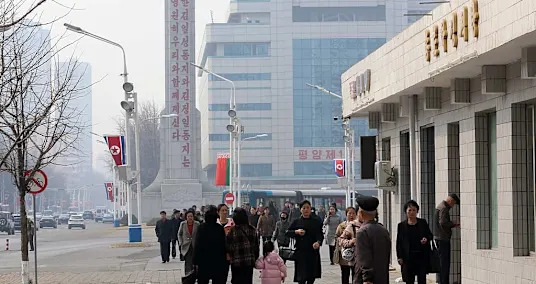
China has announced that its flag carrier, Air China, will resume direct flights to North Korea after a six-year pause, following the restoration of passenger train services between Beijing and Pyongyang.
This marks a significant step toward reopening North Korea, one of the world's most isolated nations, to the world.
Transport links between the two capitals had been suspended since the start of the Covid-19 pandemic in 2020, when Pyongyang implemented a very strict border closure.
While North Korean carrier Air Koryo already resumed flights to Beijing in 2023 and allowed Russian tour groups to visit in 2024, the return of China's air and railways are seen as a major economic milestone, as China has for decades been the main trading partner and a key source of diplomatic and economic backing for the country of 26 million people.
Before the pandemic, there were an estimated 300,000 foreign visitors in 2019, according to South Korea's Institute for International Economic Policy, and Chinese visitors accounted for 90% of all tourists to North Korea. Therefore, the long delay in resuming regular travel had surprised many regional observers.
"The reopening of these borders has been driven primarily by Pyongyang's timeline, which challenges the outdated assumption that Beijing dictates terms to a dependent client state," Seong-Hyon Lee, a visiting scholar at the Harvard University Asia Centre, explains.
Related
Nuclear ambitions complicated the relationship
Despite being Pyongyang’s primary ally, Beijing has frequently voiced disapproval over the North's persistent missile tests and nuclear ambitions. This aspect created a bumpy relationship with Pyongyang, with analysts saying that a nuclear-armed North Korea has often been something of a liability.
The diplomatic normalisation was highlighted last September, when Kim Jong Un attended a massive military parade in Beijing alongside Russian President Vladimir Putin. This was Kim's first appearance at a Chinese military display.
Lim Eul-chul, a North Korea expert at South Korea's Kyungnam University, argues that the war in Iran, in particular, increased "the need for closer coordination between the two nations".
NEUESTE BEITRÄGE
- 1
 Sanofi to acquire hepatitis B vaccine maker Dynavax for $2.2 billion24.12.2025
 - 2Don't miss Jupiter shining close to the waning gibbous moon on Dec. 706.12.2025
- 3Last supermoon of the year, the cold moon, seen across the U.S.: See the photos05.12.2025
- 4Reporter's notebook: Inside the IDF’s ‘Hamas Village,’ and how Israel is rewriting urban warfare19.11.2025
- 5From blowouts to big interiors, ‘Tuscan Mom’ style is Gen Z’s answer to beige burnout01.04.2026



Ähnliche Artikel
- Monetary Versatility: Get ready for Life's Unforeseen Difficulties01.01.1
- The most effective method to Go Down Abundance through Ages with Disc Rates19.10.2023
- How did Ariana Grande get her Glinda voice? I’m the man behind the magic.19.11.2025
- Indonesian Mega-Farm Drives Surge in Deforestation31.03.2026
- White House responds to Sabrina Carpenter after pop star slams 'evil' ICE video using her song02.12.2025
- Find the Advantages of Careful Eating: Developing a Sound Connection with Food14.07.2023
- Best Getaway destination: Ocean side, Mountain, or City01.01.1
- UK consumer confidence plunges amid escalating Iran conflict27.03.2026
- Drones haven't won the fight in Ukraine. That matters as the West learns new ways of war.27.03.2026
- Dental Embed Innovation: An Achievement in Helpful Dentistry06.11.2023